By Dave Earle, President & CEO
Mandatory Entry-Level Training (MELT) for Class 1 commercial drivers became a prerequisite for the Class 1 road test in British Columbia on October 18, 2021. The promise was straightforward: better training leads to better-prepared drivers. With four years of data now available, the results should speak for themselves.
But do they?
Commercial driver training requirements in BC historically varied across providers, raising concerns about inconsistent training quality and driver preparedness. In response, the Province introduced MELT, requiring individuals seeking a Class 1 commercial driver’s licence to complete a standardized program before attempting the road test. BC’s MELT framework mandates a minimum of 140 hours of instruction, covering classroom learning, yard training, and on-road driving, delivered by licensed training schools.
ICBC publishes road test pass/fail outcomes through a public dataset. Using data from January 2020 onward, BCTA has compared testing outcomes before and after MELT’s implementation.
Overall Testing Activity
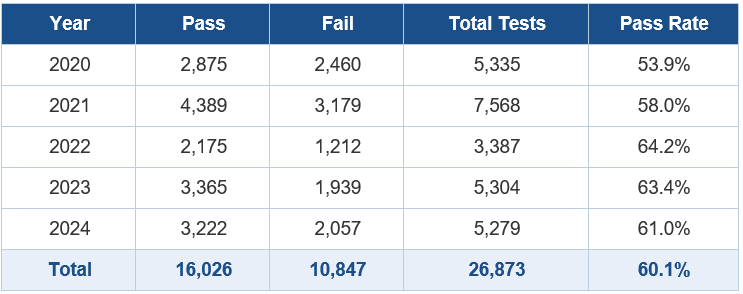
Testing volumes remained relatively stable throughout the 2020–2024 period, suggesting that MELT did not significantly reduce the number of individuals pursuing a Class 1 licence. Across 26,873 Class 1 road tests conducted between January 2020 and December 31, 2024, a total of 16,026 resulted in a pass and 10,847 in a fail, producing an overall pass rate of approximately 60 percent.
Class 1 Road Test Outcomes by Year
Did It Work?
Pass rates did increase modestly after MELT was implemented- from 56 percent in the pre-MELT period to approximately 63 percent afterward. Testing volumes also held steady, which is good news: the training requirement did not discourage individuals from pursuing a Class 1 licence.
But is this the outcome we expected?
Far from it.
MELT was designed to ensure that driver competency is developed and assessed throughout training, not just at the road test. BC’s MELT framework includes time for training schools to work with students, identify gaps, and provide additional coaching before sign-off. After multiple checkpoints throughout that process, those who designed and implemented this program – including the BC Trucking Association – can and should be disappointed in these results.
BC Trucking Association (BCTA) members are telling us exactly what the data shows. Carriers report that, on balance, new Class 1 drivers are not meaningfully better trained today than before MELT was introduced. Newly licensed drivers are still not consistently presenting with the foundational skills required to operate a heavy commercial vehicle safely.
Our members are also reporting that the most important factor when hiring a new driver is where they received their training. That should not be the case. MELT was built as a standardized framework, yet the results tell a different story.
What’s Next
BCTA is working closely with ICBC to raise the bar on training quality across all licensed schools. ICBC staff have done, and continue to do, commendable work with the tools at their disposal. But BCTA believes it is time for more: stronger oversight, clearer accountability, and higher standards across the board.
More on that soon.