

Member Marketplace
Your go-to destination for business-to-business advertising within our BCTA community.
Member Marketplace
Your go-to destination for business-to-business advertising within our BCTA community.
ADVERTISEMENT: FEATURED CONTENT*
B.C.’s Dashcam Mandate Creates an Opportunity for Safer Roads Across Canada
By Sabina Martin, Vice President, Product Management, Geotab
 Every serious collision leaves a lasting impact on drivers, families and communities.
Passed in May 2026, Bill M217 — the Dashboard Cameras in Commercial Vehicles Act — makes British Columbia the first Canadian province to mandate dash cams on commercial vehicles. The legislation requires commercial trucks weighing over 11,793 kg that operate on B.C. highways to be equipped with unobstructed, forward-facing cameras. Establishing clear technical baselines, the law dictates that these devices must continuously record the roadway ahead in at least 1080p resolution, feature night vision capability and retain a minimum of 72 hours of footage.
British Columbia’s decision to require outward-facing dash cams on commercial trucks comes after a series of tragic highway crashes and reflects a shared goal across the transportation industry: preventing more lives from being lost on Canada’s roads.
As a Canadian company headquartered in Oakville, Ontario, Geotab has spent more than two decades helping fleets improve safety through data insights and technology. British Columbia’s new mandate is an important step forward.
Many fleets have already adopted dashcams voluntarily because they provide greater visibility into what happens on the road. Video can help clarify the circumstances surrounding a collision, speed up investigations, lower insurance premiums and exonerate professional drivers when they are not at fault; dashcams help good drivers tell their story when incidents occur.
They can also play an important role in protecting the drivers themselves. Dashcams and video telematics can help identify signs of fatigue, distraction and other risky behaviours, providing real-time alerts and coaching that can help drivers stay safe behind the wheel.
With AI, the greater opportunity now lies in what happens before a collision.
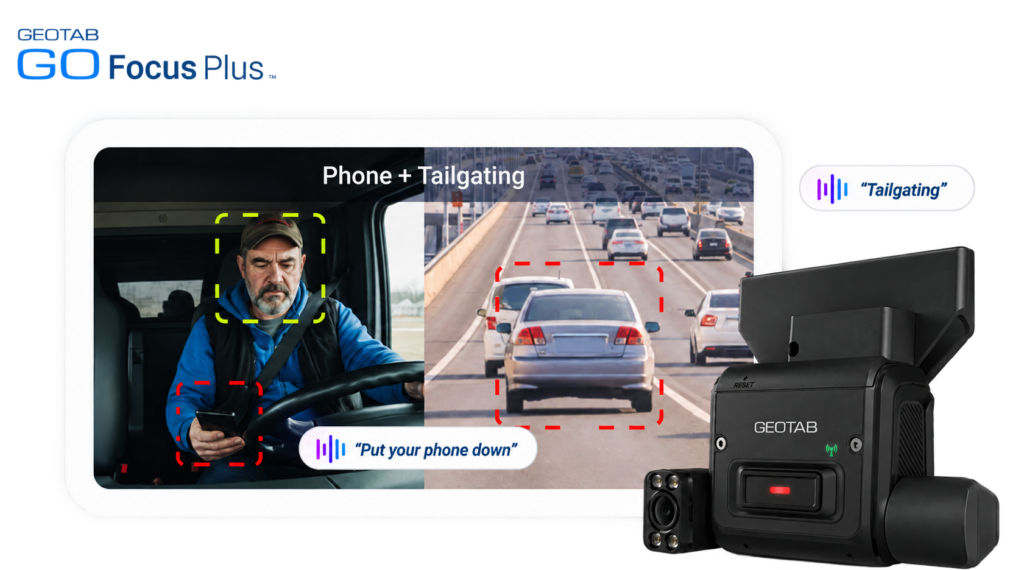 Video telematics, vehicle data and AI are helping fleets move beyond reacting to incidents, toward identifying risks earlier. By analyzing data patterns associated with fatigue, distraction, harsh driving, weather conditions, and traffic congestion, fleets can better understand where elevated risk exists, predict the likelihood of a collision and take action before a serious event occurs.
These insights not only help fleet managers improve safety programs, but they also give drivers timely information and coaching in the cab that can reduce risk on every trip.
For decades, safety efforts have focused on understanding what happened after a crash. Today’s technology, such as dash cams and in-cab coaching, makes it possible to learn from and recognize emerging risk patterns and support interventions that can help prevent collisions altogether.
This shift matters because commercial transportation operates in a complex environment. Professional drivers navigate some of the most challenging road conditions in North America while keeping Canada’s economy moving.
Equipping fleets with better information helps support safer decisions, stronger coaching programs and more effective safety strategies.
As these discussions continue nationally, it will be important to balance safety outcomes with practical implementation, clear privacy standards for drivers, and consistency across jurisdictions. British Columbia’s focus on outward-facing cameras recognizes the importance of maintaining that balance while advancing road safety objectives.
Commercial transportation connects communities, delivers essential goods and supports businesses across the country. Safer roads benefit everyone who relies on those networks. British Columbia’s mandate represents a growing recognition that better visibility, better data and emerging technologies can help create safer outcomes for drivers and the public alike.
The more we learn about the conditions that contribute to collisions, the better positioned we are to prevent future tragedies.
As this regulatory landscape evolves, we encourage fleets nationwide to look beyond basic compliance to support the transportation sector in implementing scalable, privacy-conscious safety technology that protects professional drivers and all drivers and communities across Canada.
For more information, please visit the Geotab website.

Advertise With Us!
If you need help developing artwork or content, just let us know. To book your advertising space, simply click on Book Now to complete the request form!
Have questions? Contact us– we’re happy to help.
Join the list!
Sign up for our newsletter and get updates on all things BCTA. Be the first to know! The latest trucking news and free resources sent straight to your inbox.
Join the list!
Sign up for our newsletter and get updates on all things BCTA. Be the first to know! The latest trucking news and free resources sent straight to your inbox.